

Learn the Basics of Google Ads
Google Ads is one of the most efficient and popular advertising tools in the world.
Google Ads allows you to create ad content, select your targeted audience, and reach your target.
Benefits:
- Advanced targetting such as demographics, and keywords
- Advertising based on personal budget
- Advertising tracking which creates an opportunity to tweak your ads

Choose Where Customers See Your Ads
With Google Ads you can alternate, or combine your advertising strategies.
You may choose to:
- Advertise on Search Network (Google Search, Google Maps, Google Play)
- Advertise on Display Network (YouTube, Blogger, Gmail)
Depending on your targetted audience, advertising objectives, and advertising platform,
Google Ads allows you to choose between many ad formats, such as video ads, text ads,
responsive ads, shopping ads, etc. This would mainly depend on your business model.

Create Effective Text Ads
Now that we have discussed different ad formats, we can dive into the ad world.
A simple guideline for text ad is to include a clear headline, intriguing descriptive text,
and a call to action. This guideline will help you create impactful, yet simple text ad.
Google recommends 5 tips for effective text ads:
- Highlight what makes you unique
- Use a call to action
- Include sale terms
- Match your ad to your keywords
- Match your ad to your landing page
Enhance Your Ad With Extensions
Ad extension can be quite significant when it comes to higher clickthrough rates.
Just like ad formats, ad extensions come in a few different forms. You may choose
from call extensions and sitelink extensions. Each one depends on the goals of your business.
One more incredible thing about this Google Ad feature is Google’s ability to choose
when the extension will appear to your targetted audience, all in order to increase
clickthrough rates, and conversions.

Choose the Best Campaign Types
In order to begin advertising, the first step is to create a campaign.
The most popular advertising campaigns are:
- Search campaign
- Display campaign
- Search campaigns with Display opt-in
- Video campaign
- Shopping campaign
- Universal App Campaign
Once you’ve selected your campaign type, you must select your campaign goals.
The goals you set up help the Google Ads optimize the features within your ad,
and increase probabilities of your ad becoming successful.
Organize Your Account for Success
In order to have efficient ads, it is important to stay organized. When running multiple
ads at the same time, it can become overwhelming, and if you are not organized you
might miss out on opportunities to tweak the ad in order to improve its success.
Google Ads offers features that allow you to remain organized. It is highly recommended
to create separate campaigns for different product areas, promotions, or regions, as well
as create separate ad groups with relevant keywords and bids for each product or service.
Lastly, once you become great at ad management, you can upgrade to Google Ads Manager
account, which allows you to run multiple accounts.

Reach Customers With Targeting
There are three questions you will need to consider when targeting your audience.
- Who
- Where
- What
These will help you narrow down your audience in order to achieve your advertising goal.
One amazing feature Google Ads come with is a remarketing option, where you can target
customers who engaged with your ad but haven’t purchased the product or service.
This strategy has the potential to convert the engaged audience into buyers.
Help Customers Find You
When customers are searching the web, they are entering keywords into the search engine.
The words your targeted audience is looking up are the words you should use within your ad.
This will make your ad appear on their search engine once they look up those keywords.
There is an amazing feature that I highly recommend, and it’s using negative words. Using
negative words will help you avoid appearing to unwanted audiences.
Control Which Searches Trigger Your Ads
Just like negative words usage can help you avoid unwanted audiences, so can match types.
But what does this mean? Match types allow you to control which variations of your keywords
cause your ad to show to potential customers.

Make Your Ads Seen
When it comes to advertising, not all ads are relevant to all the customers, and Google Ads auctions
is in charge of that.
Factors that determine your ad visibility:
- Bid
- The quality score
- The ad format
- Ad rank
Match Media Cost Models With Your Budget
Simply said, each business model has different needs. It is important to keep this in
mind when deciding which advertising model you will be using.
Here’s a simple breakdown:
- CPM – When trying to raise brand awareness
- CPC – When trying to drive traffic to the website
- CPA – When trying to increase sales
- vCPM – When trying to raise brand awareness but only pay for
impressions measured as viewable - CPV – When trying to increase video views

Determine a Good Bidding Strategy
There are three tools that determine a good bidding strategy:
- Bid Simulator
- Keyword planner
- First-page bid estimates
Using each one accordingly can help you change your ads to optimize them
to the fullest.
Select Your Bid Strategy
Bidding strategy can be either manual or automated. Before you choose one
you should consider your current ad statistics, and your future ad goals.
The manual bidding strategy is great if you’d like to have full control over
the budget, and do not have enough conversions to be qualified for automated
bidding. If you do, however, have enough conversions, and would like to use
your time differently, you are free to choose automated bidding strategy, and
let Google Ads do its charm when it comes to successful advertising.
Adjust Bids to Favor Performers
As an advertiser it is crucial to think like a user. Having this kind of mindset
can help you adjust your bids in order to achieve best results. You can rise or
lower all of your bids, depending on the results you’re trying to get.
Bidding higher will allow you to increase visibility with your targetted
audiences, or perhaps bid different amounts for different user devices.
Available bid adjustments:
- Device
- Location
- Time of day
- Top content
- Targeting methods
- Remarketing lists for search ads
- Interactions
Align Your Budget With Your Goals
Before you can attempt any aadvertising strategy, you must consider your budget.
Your daily budget can be calculated either through your personal estimated budget
per day, pay per click method, or through recommended daily budget.

Evaluate Campaign Performance
Evaluation of your campaign’s performance is one of the most important aspects
of advertising. The statistics about performance can help you adjust your ad in
the ways that would improve its success.
Some of the way you can base your evaluation from are:
- Impressions
- Clicks and clickthrough rate
- Conversions
- Cost per conversion
- Conversion rate
- Return on investment – ROI
Avoid Editorial Errors
If you thought this is all, you are wrong. There are a few more simple tips
I can provide when it comes to advertising. Did you know Google might
refuse your ad due to spelling errors, poor punctuation, unnecessary
symbols such as emojis, and including your contact information
within the ad? Well, now you know! Make sure you always proofread!
Address Trademark Disapprovals
Last, but not least, is trademarks affecting your advertising. When attempting
to publish your ad, Google Ad will do one of the following three things:
approve it, approve it with some limitations, or disapprove it.
Chances are it was due to the usage of the trademark.
There are a few things you can do to resolve the issue:
- Simply remove the trademark and publish again
- Contact the trademark owner and request authorization for usage

Conclusion
As a personal eCommerce business owner, I’ve learned over the years that
being cheap, when it comes to advertising, is merely a waste of time, and money.
It is okay to stay within the budget; however, in that case, I recommend to continuously
alter your ads based on the statistics such as ROI, clickthrough rates, and conversions.
Becoming a good advertiser takes time. Not every format of ad will work for every product,
and it is ultimately a game of trial and error until you discover what works for your
business, your products, and your consumer base.
One of the great first steps is to take Google Ads Fundamentals course, as well as test
your knowledge through the Google Ads Fundamentals Assessment. As I went through
the course, I have discovered aspects of advertising that I’ve overlooked, or others
never mentioned. The first time I took the test I failed with 78%. It was a good realization
of my “expertise”, and a grounding experience that inspired me to further explore advertising.
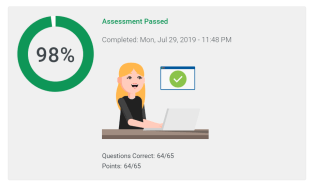 The second time I took the test I got 98%. I felt proud
and more knowledgeable on the topic. Most importantly,
I felt inspired to practice my advertising skills and take
my business to anew level.
What I would personally recommend for any startup business is to firstly focus on raising brand
awareness, and the clickthrough rate. Focus on your landing pages. The landing page has to be
even better than the ad. If the ad is great, the customer clicks on it, and then lands on
average page, or a page that is not related to the ad, they will be less prone to buying.
I like to think of good advertising as a cycle. Your targeted audience, your ad, your landing
page, customer experience, and customer loyalty, are a cycle. Once you target your consumer,
through your ad, they will land on your landing page. Depending on their experience, they
would buy a product, wait for it, receive it, use it. Based on their overall experience they
would turn into a loyal customer, and organic traffic. Good advertising can help create this
cycle, and ultimately ensure the success of your business.

Example
As today’s example I will talk about personal advertising experience.
When I just started eCommerce, I was attempting to save a buck everywhere I could.
I used a free template, free apps, free plugins, and tried to be cheap when it came to
advertising.
I decided, as per advice of many “eCommerce, claimed-to-be, experts”, to spend $5
per day on advertising. That seemed to fit the budget. I went for it. Blindly. I had no
idea how to advertise, what are the different formats, how to check the statistics,
manual versus automated strategies etc. All I knew was how to write and design my
ad. My ad was a waste of money. At the end of the month I realized I didn’t make
a sale, and now my ROI was negative.
The next month I have decided to go through Google Ads Fundamentals course
and stop listening to “eCommerce experts”. This time around I have decided to
focus on keywords, and different ad formats. I created 5 different ads in the
same category. I have also decided to increase my budget per each ad.
As mentioned in the course, bid amount, format, and keywords, are in fact all
playing a role on your ad placement, position, and success. Few of the ads were
money wasters. The format or keywords were simply not a match for my target
audience. However, two of them were having good clickthrough rates. This made
me focus on specific format and keywords. I stopped the three ads that weren’t
successful, and increased my bids for the other two that had traffic.
Sure enough, free template, free apps, and free plugins have proven to not be an issue,
during the testing phase. It was the ad format, and keywords, that played a role.
Once I knew what to focus on, how to alter changes, instead of waiting out, I was
on the right path. My ROI on that second month was still negative; however, I made
12 sales in three weeks, and it simply meant I was on the right track. It motivated me to
keep learning, keep testing, and altering, until I discover what works for my brand,
my style, my customer base, and my business.
Disclaimer
All the information, except personal experiences, is gathered from Google Ads Fundamentals
course, and is by no means endorsed or sponsored by Google Ads.
 Entrepreneurial Travel Blog